Fat-Burning Training Zones Explained

Fat-Burning Training Zones Explained

Fat-Burning Training Zones Explained:

Are You Really Burning Fat When You Work Out?

One of our Over Fifty Fitness subscribers asked about fat-burning heart rate zones the other week. She was confused by the conflicting information on the internet and concerned that she wasn’t burning fat when her heart rate got too high.

You might have heard it discussed as Zone 1, 2, 3, 4 & 5 – with a strong push for Zone 2 heart rate (60% of your maximum heart rate).

The premise is that the lower the training heart rate is, the more fat you use as a fuel source.

We in the fitness industry agree about these zones and fuel sources. What frustrates us, though, is the lack of information given to the public about these zones.

Reading the chart above makes one think that the harder you work out, the less fat you use as a fuel source.

While that is correct, it doesn’t give you the whole picture.

Yes, you are using fat as a fuel source in these lower zones, and then when you exercise harder, your body tends to get its fuel from carbohydrates or glycogen, because these are easier for your body to break down quickly.

However, there is A LOT more to this.

While it is true that the body burns fat as a fuel during low-intensity workouts, the fat-burning rate remains low, and you have to exercise longer to burn the same amount of calories you would at higher intensities.

Because it’s the total number of calories you burn that leads to the most weight (and fat) loss.

In a high-intensity workout, although your body uses your carb/glycogen stores first for ‘fast energy’, it depletes the glycogen stores rapidly enough to force your body to tap on the fat storage.

Additionally, the fat-burning zone (Zones 1 & 2) lacks an exercise afterburn effect.

Research has proven that the harder you work out (Zones 4 and 5), the more afterburn you will experience.

The afterburn effect, also known as excess post-exercise oxygen consumption (EPOC), is a physiological response to intense physical exercise, which means the body continues to burn more calories for several hours after the workout.

It’s using more fuel to get your body back to homeostasis.

If fat loss is your goal, the best way to burn fat is to work out at higher intensities — pushing your heart rate to around 70 percent or more of its maximum ­— while adjusting your diet to consume fewer calories.

It’s worth noting that new exercisers or those with joint or medical issues may find working at 70 percent or more of their heart rate maximum for 5-6 days a week extremely fatiguing.

So, my advice is to aim for 1-2 workouts a week in Zones 4 & 5, and 3-4 workouts a week in Zones 2 & 3.

You won’t burn yourself out, your joints will continue to love you, and if you have modified your diet (because fat loss is 75% of what you eat – or don’t eat), you’ll burn that body fat.

Deal? Deal!
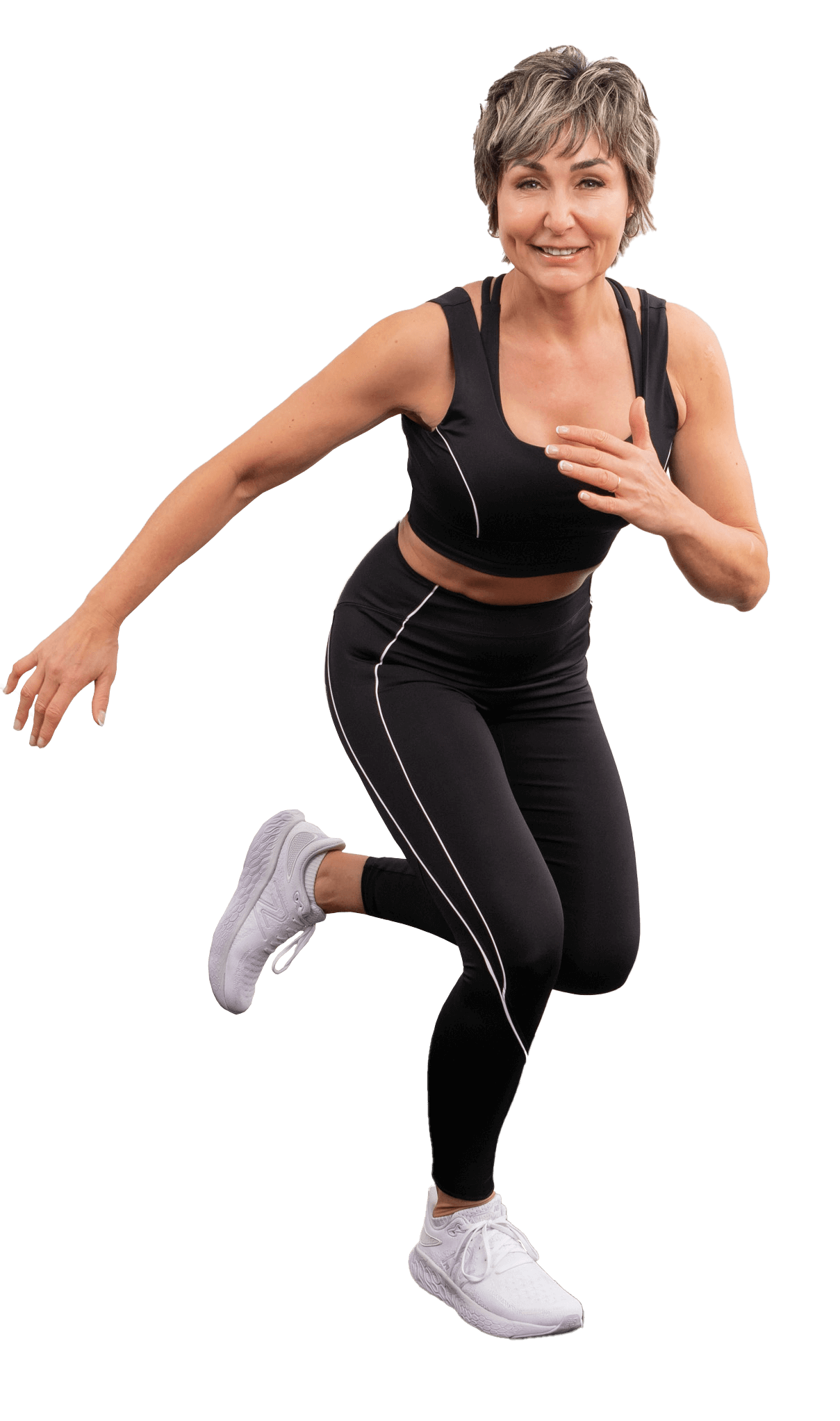
Hi, I’m PJ Wren.

I’ve been working with people of all ages, all fitness abilities, and varying fitness goals for over two decades.

I’ve helped thousands of women over the years who are just like you, feel more energized, stronger, and more confident in their bodies. I turn gym goers and non-believers of getting fit at home into believers, with at-home workouts that will give you the results you want, no gym equipment or crazy diet required!

I’m passionate about women over 40 because I am over 40 myself.

I know what it feels like to be middle-aged, and what it’s like to have a hot flash while looking for my bloody reading glasses.

I’m honoured you choose me, in the HUGE ocean of fitness professionals, to help you get fit, get strong and get fierce.

I promise to only give it to ya straight while listening to what you want, and what you need.

ox PJ

Dumbbell Guide: How much weight should you lift

Dumbbell Guide: How much weight should you lift

Dumbbell Guide: How much
weight should you lift?

Top Picks for Beginners, Intermediates & Advanced (Plus Exercise Matchups)

One of the awesome perks of having a personal trainer is that we fetch your dumbbells. It’s like having your personal fitness concierge!

But really, what we’re doing is making sure you aren’t grabbing too light a weight.

Trust me; nothing makes a trainer want to curl up in a ball and cry more than watching a client go for the 5 lb dumbbells on a lift that can take two, three or even four times that amount.

So, what do you do when you’re at home working out to my YouTube or my OFF (Over Fifty Fitness) videos?

Here are some general recommendations for the size of dumbbells to start with and the appropriate sizes to use for each of the body’s different muscles.

Please remember, though, that these are generalized.

Previous injuries, previous experience and your confidence with the exercise will affect how much weight you can lift.

But what doesn’t affect what size dumbbells you use, though, is your age!

I have trained 65-year-olds with the same size dumbbells I use for my own workouts, as they had experience with the lift.

In fact, the older we are, the heavier the weight we need to work towards to decrease sarcopenia (muscle wasting) and osteoporosis.

There is an exception, though.

In over 30 years of training humans, I have found that once people reach around 70 years old, their ability to lift heavy objects decreases. Now, this is just my own experience with clients, and it could be because none of them had done any strength training before working with me.

As mentioned above, previous experience plays a significant role in determining how much weight you can lift.

So, if you are in your 70s and have been lifting for years, listen to your body and challenge yourself with what feels ‘uncomfortably comfortable’.

Women – Beginners:

Light: 3lb & 5lb
Best for shoulders, triceps & reverse flies

Moderate: 8lb & 10lb
Best for chest & biceps

Heavy: 12lb
Best for legs & back

Women – Intermediate (exercising 3+ months):

Light: 8lb & 10lb
Best for triceps & reverse flies
Note: for exercises like external rotation for the rotator cuff, 3lb-5lb is recommended.

Moderate: 12lb & 15lb
Biceps, shoulder presses

Heavy: 20lb & 25lb
Best for multi-joint leg exercises, chest presses, rows

Women – Advanced (exercising 12+ months):

Light: 10lb & 12lb (also have 5lb & 8lb for high rep workouts)
Best for reverse flies
Note: for exercises like external rotation for the rotator cuff, 3lb-5lb is recommended.

Moderate: 15lb & 20lb
Best for triceps & biceps

Moderate Heavy: 25lb
Shoulder presses

Heavy: 30+
Chest presses, multi-joint leg exercises, rows

I hope that helps you, and here’s to lifting heavy for life!

Hi, I’m PJ Wren.

I’ve been working with people of all ages, all fitness abilities, and varying fitness goals for over two decades.

I’ve helped thousands of women over the years who are just like you, feel more energized, stronger, and more confident in their bodies. I turn gym goers and non-believers of getting fit at home into believers, with at-home workouts that will give you the results you want, no gym equipment or crazy diet required!

I’m passionate about women over 40 because I am over 40 myself.

I know what it feels like to be middle-aged, and what it’s like to have a hot flash while looking for my bloody reading glasses.

I’m honoured you choose me, in the HUGE ocean of fitness professionals, to help you get fit, get strong and get fierce.

I promise to only give it to ya straight while listening to what you want, and what you need.

ox PJ

Do you really need to train your abs?

Do you really need to train your abs?

Do You Really Need to Train Your Abs?

Let’s Find Out!

Do you really need to train your abs?

The answer is yes, but not for the reasons many people train their abs.

Contrary to what many believe, doing endless crunches won’t magically burn away belly fat.

Here’s the scoop: When we exercise, our muscles can’t choose where to burn fat from. Fat in our bodies is stored as triglycerides, which our muscles can’t access directly. Instead, they break down the triglycerides into free fatty acids and glycerol, which are then delivered to our muscles through the bloodstream.

When we exercise, we burn fat from all over our bodies, not just the specific area we aim to target.

So forget about spot-reducing. It’s a no-go.

And talking about those dreamy, flat abs. Guess what?

It’s more diet-based than movement-based, and it is a whole lot of hard, freaking work to get that 6-pack. I’m speaking from experience here. My abs were on point in my mid to late 40’s.

But here’s the thing: I realized that life was more fun when I stopped obsessing over my diet and carb intake. Goodbye restrictions, hello happiness!

So, why bother training your abs?

Stronger abs can help reduce back pain, allow you to lift heavier during your workouts, and add stability to your core.

Now, here’s a little tip: if you lift weights, you don’t need to focus too much on training your abs separately.

Why? Because exercises like squats, deadlifts, rows, snatches, cleans, and lunges already engage your abs big time. The abs are engaged with your lifts to prevent your body from rotating, extending, or flexing laterally. All these movements are key when it comes to training your core.

But wait, there’s more!

You should also incorporate some flexion-based exercises, as your abs flex your spine as well. And to my osteo-friends out there, you can go for a McGill curl-up.

I recommend 1-2 extra ab-specific sessions a week, and if strengthening your core is a goal, then bump that up to 3-4 sessions.

To help you, I try this crunch-free ab workout, or hit up my core playlist on YouTube. And if you want to get those abs strong, do my 21-day abs challenge on Over Fifty Fitness. That will get those abs STRONG!

Related workouts

Hi, I’m PJ Wren.

I’ve been working with people of all ages, all fitness abilities, and varying fitness goals for over two decades.

I’ve helped thousands of women over the years who are just like you, feel more energized, stronger, and more confident in their bodies. I turn gym goers and non-believers of getting fit at home into believers, with at-home workouts that will give you the results you want, no gym equipment or crazy diet required!

I’m passionate about women over 40 because I am over 40 myself.

I know what it feels like to be middle-aged, and what it’s like to have a hot flash while looking for my bloody reading glasses.

I’m honoured you choose me, in the HUGE ocean of fitness professionals, to help you get fit, get strong and get fierce.

I promise to only give it to ya straight while listening to what you want, and what you need.

ox PJ

Protein does a body good

Protein does a body good

Protein does a body good

especially with fat loss

Let’s talk about fat loss.

I don’t often chat about fat loss; however, I do have one pointer I would love to share that could jumpstart your goal.

Protein helps you lose body fat, even without conscious calorie restriction.

In one study of 19 overweight individuals, increasing their daily protein intake to 30% of calories caused a massive drop in calorie intake (PubMed).

This is because eating more protein:

  • Leads to reductions in carvings
  • Reduces the desire for late-night snacking
  • Reduces your appetite, making you eat fewer calories throughout the day
  • Makes you burn more calories by increasing your metabolism
  • Changes the levels of several weight-regulating hormones. A higher protein intake increases levels of the satiety (appetite-reducing) hormones GLP-1, peptide YY and cholecystokinin, while reducing your levels of the hunger hormone ghrelin.

In the study I mentioned above, the participants lost an average of 11 pounds over a period of 12 weeks by only adding protein to their diet.

They did not intentionally restrict anything else.

That’s pretty incredible.

So, how much protein is optimal?

According to most of the studies, aiming for protein at 30% of your calories is very effective for fat loss.

You can find the number of grams by multiplying your calorie intake by 0.075. For example, on a 2000-calorie diet, you would eat 2000 * 0.075 = 150 grams of protein.

You can also aim for a certain number based on your weight. For example, aiming for 0.7-1 gram of protein per pound of lean mass is a common recommendation (1.5 – 2.2 grams per kilogram).

It is also best to spread your daily protein intake by eating protein with every meal, and keep in mind that these numbers don’t need to be exact; anything in the range of 25-35% of calories should be effective.

I aim for 25-30 grams of protein for my 3 main meals, and then I usually have a protein shake for my afternoon snack with protein powder and 5 grams of creatine. I’ve eaten like this for decades, and I very rarely have cravings or feel the need to snack late at night.

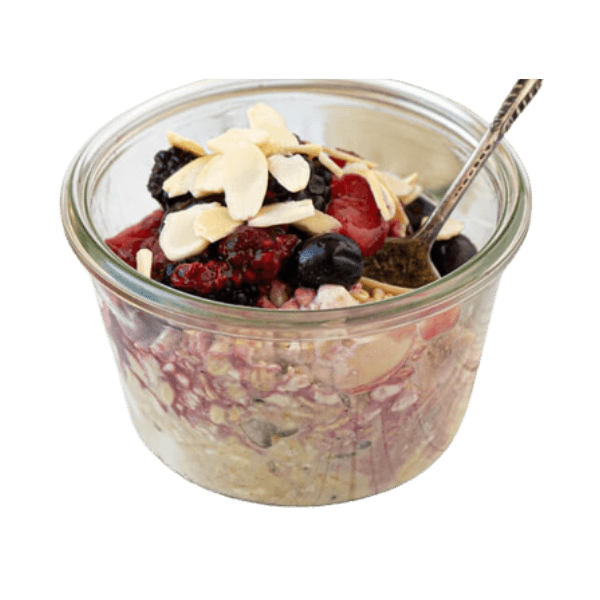
To help you out, I have attached a high-protein Berry Cottage Cheese Overnight Oats that our nutritionist on Over Fifty Fitness released to the group a few months ago.

Give it a download, and let me know what you think!

Berry Cottage Cheese Overnight Oats

Hi, I’m PJ Wren.

I’ve been working with people of all ages, all fitness abilities, and varying fitness goals for over two decades.

I’ve helped thousands of women over the years who are just like you, feel more energized, stronger, and more confident in their bodies. I turn gym goers and non-believers of getting fit at home into believers, with at-home workouts that will give you the results you want, no gym equipment or crazy diet required!

I’m passionate about women over 40 because I am over 40 myself.

I know what it feels like to be middle-aged, and what it’s like to have a hot flash while looking for my bloody reading glasses.

I’m honoured you choose me, in the HUGE ocean of fitness professionals, to help you get fit, get strong and get fierce.

I promise to only give it to ya straight while listening to what you want, and what you need.

ox PJ

Sign UpTo Receive Your 21 Day Fitness Program

Start receiving your personalized fitness program by entering your name, email, and answer 2 simple questions.

Do you currently work out?
Fitness Goal

WE HAVE LIFT OFF! Now, go head to your In Box to confirm your subscription so I can send you your first workout 👊🏼